There are several basic elements
to managing stress everyday:
1. Physical factors
2. Nutritional Stress
3. Climatic Stress
4. Emotional Stress
Physical factors: Whenever we are
stressed to meet deadlines, deal with interpersonal relationships that are
tenuous--children misbehaving, supervisors making demands, and so on--the
fight or flight part of our nervous system gets involved. We are impacted
much the same way as if we were being physically threatened and it happens
whenever our ego is threatened.
When we speak of the fight or
flight we usually think of one reacting to a physical threat such as the
saber tooth tigers with which our ancestors had to deal. However, the
fight or flight (the sympathetic nervous system is activated any time our
egos are threatened as in our financial position, family status, work
status, personal status.
When the fight or flight is
activated, our breathing becomes tense and upper chest, we brace and our
muscles tighten, our blood flow to the extremities is hampered, stomach
stops digestion, heart rate increases, sweat glad activity is activated,
circulation to our extremities is reduced...
The essence is that our body is
made ready to either fight or run from a threat. However, for the majority
of threats running or fighting is not a practical solution. For instance,
your supervisor gives you constructive criticism. You wouldn't fight him
or get up and run away from his critique, would you? Yet your body has you
ready to do this.
And what's even more interesting,
you are holding onto physical tension and unaware of it. It's not a super
high level of tension, but none the less, when you hold onto it you:
1. Become acclimated to higher
levels of tension as being normal so it's not uncommon to simply notice
that your shoulders are hunched up and tight, or that your jaw is
clenched, or...
2. The tension builds to the
point where you experience a stress related problem such as headaches,
indigestion, hypertension...
Nutritional Stress Factors:
Eating a highly refined diet
which is high in sugar and refined grains such as you'll find in pastries,
cookies, cake, pretzels... contribute to hypoglycemia. This type of diet
causes a rapid rise in blood sugar and after years of this abuse, the
pancreas eventually over produces insulin causing a rapid decrease in
blood sugar. Symptoms are nervousness, irritability, depression, anxiety
to name a few. The adrenal glands also gets involved further stressing the
body by activating the sympathetic nervous system. Essentially with poor
nutrition your responses to stress are magnified.
3. Climatic stress. Yes
environmental changes in temperature and humidity have an effect as well.
Just read the headlines during a long hot spell or a cold spell and you'll
find an increase in the number of deaths during these periods. Dehydration
in summer time is the biggest threat to health and exposure to the cold in
winter time can be life threatening. For instance, shoveling snow can be
life threatening if the person breathes through his mouth instead of
through his nose which warms the air. Breathing through one's mouth can
admit cold air into the bronchial system essentially freezing critical
arteries causing death.
4. Emotional Stress: Add social,
work, and financial pressures and we have frustration, upset, anger,
confusion, and uncertainty to deal with. It's actually nothing wrong with
these emotions, what is more of a problem is that we make the emotion
itself a stressor and instead of simply embracing emotion we resist and
fight many of these emotions or get upset with ourselves for being human.
This only serves to activate the fight or flight further stressing the
body.
Managing these stressors simply
is to become aware of the bodily responses to stress and manage them. Deep
breathing is the first defense against stress followed by learning to
recognize muscle tension and letting it go. Stress management CDs which
teach deep breathing and muscular awareness techniques go a long way to
recognizing the body's activation and letting it go. Obviously a shift in
diet away from a high sugar refined diet goes a long way to minimize one's
reactivity to stress.
Dressing appropriately, taking
breaks, drinking water, minimizing exercise in cold temperatures can
minimize one's responses to climatic stressors.
Reduce the emotional load by
learning how to embrace emotions and use them as a "call to
action" as Tony Robbins would suggest. Even though emotions have been
around for thousands of years, it's only recently that programs to
effectively deal with them are surfacing.
Strangely enough it's our beliefs
and attitudes about emotions that keep us from embracing them which
actually makes them more stressful than what they really are.
Managing stress is to on an
ongoing basis be aware of the physical factors, eat nutritionally, take
care of your body with climatic changes and handle emotions effectively.
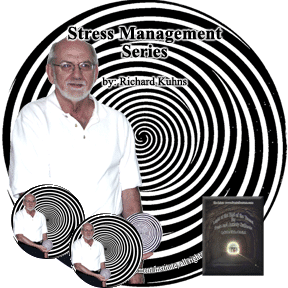
 Learn to Relax
regularly $14.95|
Learn to Relax
regularly $14.95|